
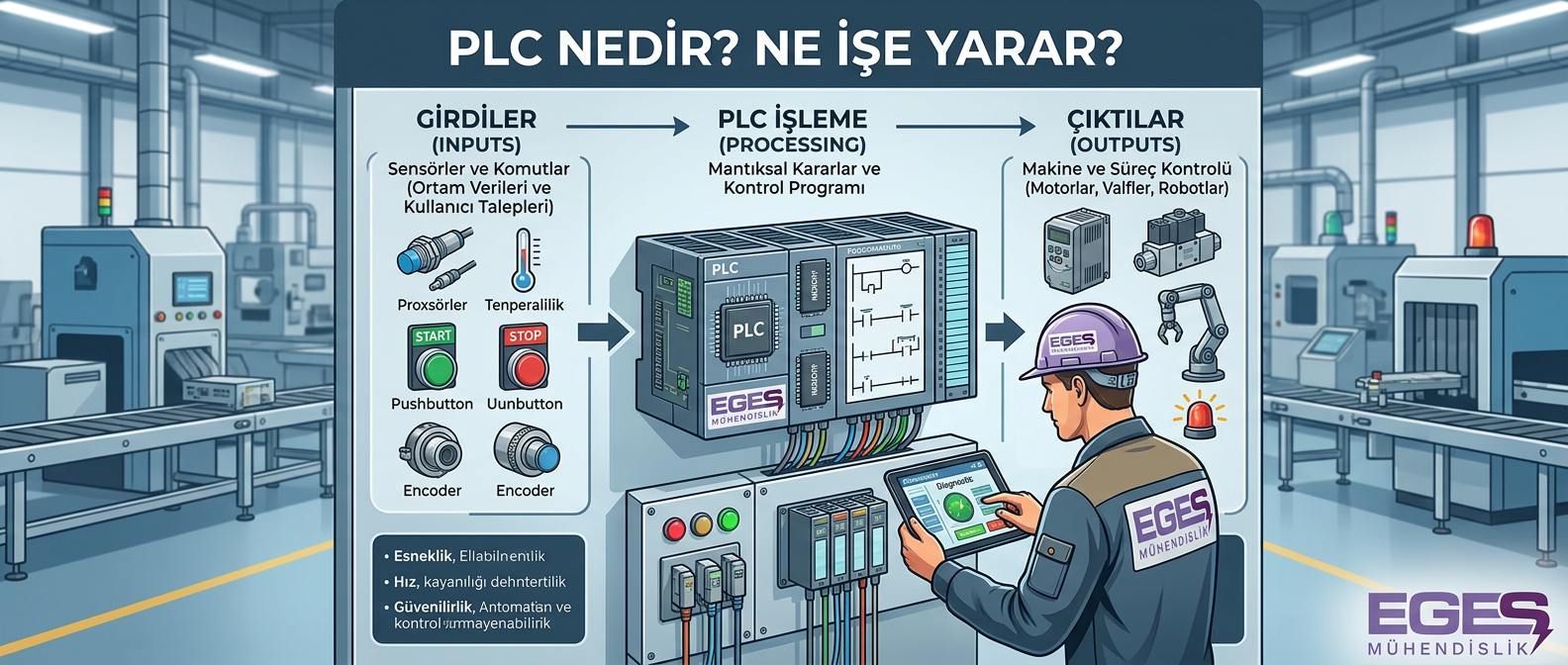
The unsung hero that ensures machines work in harmony with one another, production lines run smoothly, and complex processes are managed in modern factories PLC systems. So, what is it that we hear so often in the tech world? What is a PLC? And why is it so important?
PLC: Acronym and Meaning
First, let’s start with the basic term: What does PLC stand for?, is the abbreviation for the English term “Programmable Logic Controller.” In Turkish, it is Programmable Logic Controller has been translated as. What does PLC stand for? The simplest answer to this question is: it is a digital computer specifically designed for industrial environments that collects data from the field via input/output (I/O) units and processes it according to the program you write.
What Is a PLC Used For?
At a manufacturing facility PLC The system's primary functions are as follows:
- Process Control: It controls all types of mechanical motion, from conveyor systems to packaging machines.
- Data Collection: It reads data such as temperature, pressure, or speed from the sensors.
- Quick Decision-Making: It can process incoming data within milliseconds and stop the motors or open the valves.
- Flexibility: When you want to change the machine's operating logic, you simply need to update the software—there's no need to disassemble the mechanical components.
How a PLC Works
One PLC, it works using a cyclical logic:
- Introductory Reading: It monitors signals from sensors or buttons.
- Program Implementation: Stored in its memory PLC Programming It scans the code from top to bottom.
- Release Update: Based on the decisions made by the program, it sends commands to motors, relays, or lights.
What Is PLC Programming?
PLC Programming, is the coding process that determines how the device will respond in different situations. Unlike standard computer programming, it typically resembles electrical schematics Ladder Diagram (Ladder Logic) It is used. This allows electricians and engineers to easily understand the system's logic and troubleshoot issues.
Why Choose a PLC?
Unlike traditional relay-based systems, the advantages of using a PLC are as follows:
- Size: A device the size of the palm of your hand can do the work of thousands of relays.
- Reliability: Since it has no moving parts, it is not subject to mechanical wear and is resistant to harsh factory conditions (dust, humidity, heat).
- Debugging: You can instantly see which sensor isn't sending a signal through the software.


 Turkish
  English
  German
  French
  Arabic
  Azerbaijani