
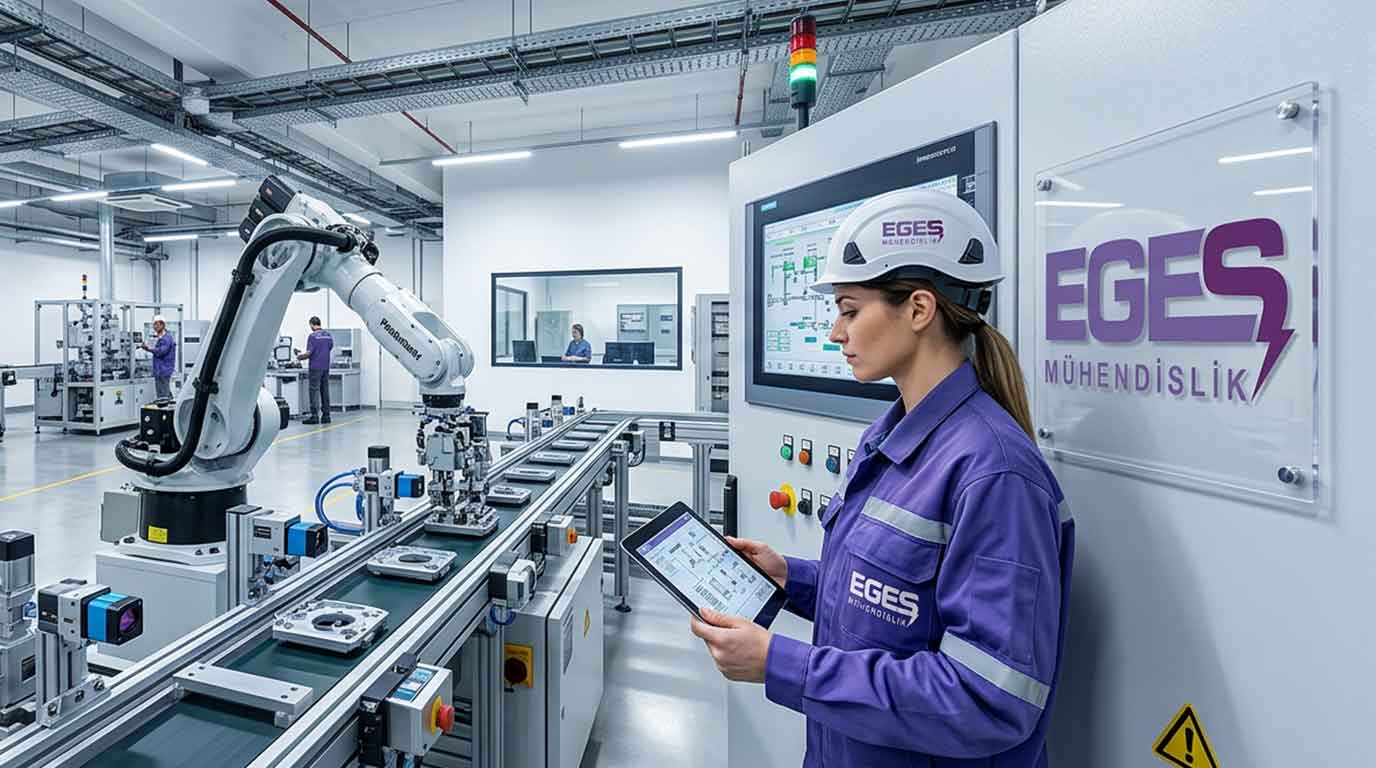
In today’s manufacturing world, the only way to achieve the goals of speed, precision, and low cost is to use technology wisely. This is where industrial automation...ensures that factories and facilities operate with minimal human intervention. So, how do these systems work, and why are they so critical?
What Is Industrial Automation?
Industrial automation...is the use of computers, robots, and information technology to control production processes and machinery. Simply put, it involves delegating repetitive, hazardous, or highly precise tasks to intelligent systems.
Frequently asked questions in the industry What is an automation system? The answer to this question is that it involves mechanical parts, sensors, and software working together as a whole within a specific logical framework (algorithm).
What Does Industrial Automation Do?
At a facility What does industrial automation do? When we look at it this way, we see that it doesn't just run the machines:
- Increases Speed: People get tired, but an automated system can produce at the same rate 24 hours a day.
- Resets Errors: People can get distracted; however, automation systems It instantly detects even micron-level errors.
- Reduces Costs: Although there is an initial investment cost, it significantly reduces labor and scrap (defective product) costs in the long run.
- Occupational Health and Safety: Machines take over tasks involving high temperatures, hazardous chemical environments, or the handling of heavy loads—tasks that pose a risk to humans.
What Is Electrical Automation?
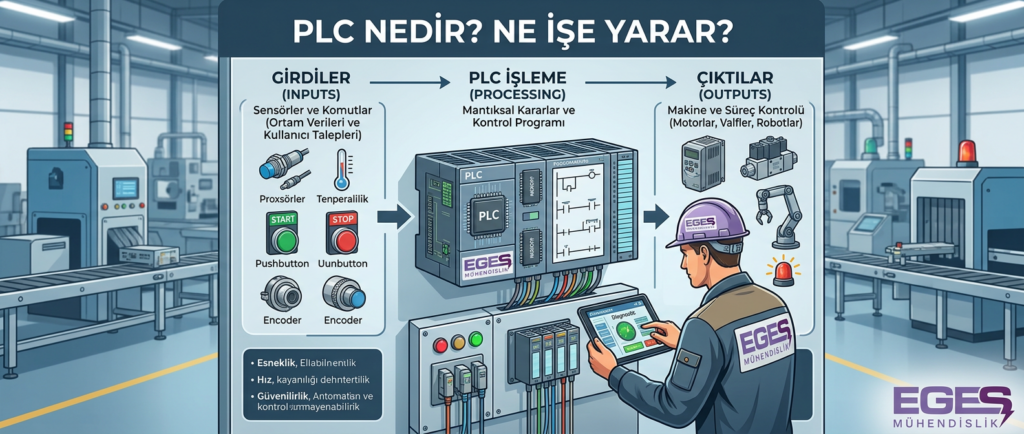
Electricity is at the heart of automation. Electrical Automation, is the process of converting data from sensors on-site (temperature, pressure, speed, etc.) into electrical signals, processing these signals, and sending commands to motors or valves. The components used in this process include industrial Control panels ensure the system operates safely and without interruption.
Key Components of Industrial Automation
A successful automation project consists of the following three main layers:
- Field Staff: Sensors (eyes) and actuators/motors (hands).
- Control Layer: Devices such as PLCs or RTUs that serve as the "brain" of the system.
- Monitoring Layer (SCADA/HMI): The screens through which the operator monitors and controls the system.
Factories of the Future and Industrial Transformation
It is no longer just a mechanical automation is not enough. With “Industry 4.0” and “Industry 5.0,” machines have begun to communicate with one another and make decisions with the support of artificial intelligence. For businesses that want to be part of this transformation, a properly designed industrial automation Infrastructure is not a choice, but a necessity.
 Turkish
  English
  German
  French
  Arabic
  Azerbaijani