
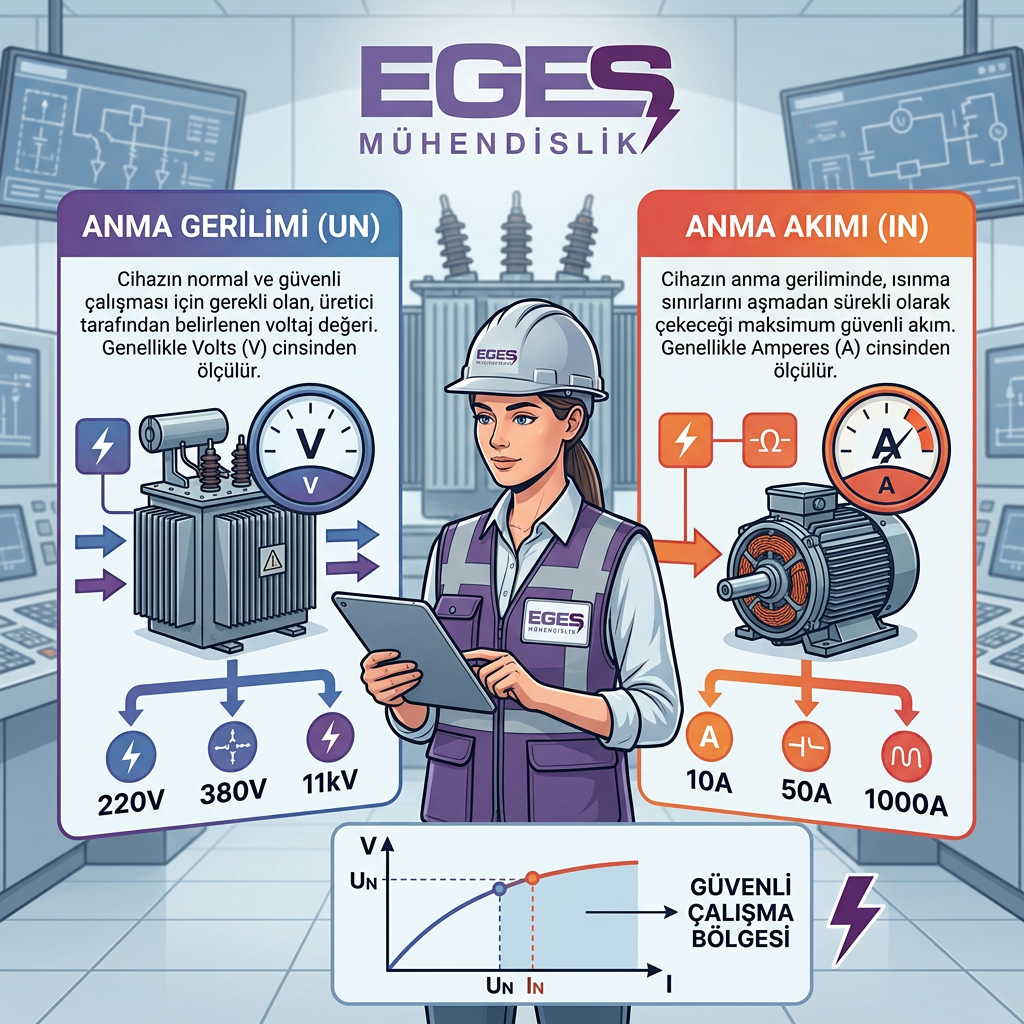
We see certain technical specifications on the metal nameplates attached to electrical devices or panels. The most important of these specifications are What is the commemoration movement? and What does "memory voltage" mean? These questions define the device’s safe operating limits. In this article, we will elaborate on these fundamental characteristics of electrical systems.
What Does "Current" Mean? What Is the Unit of Current?
Before getting into the technical details, let’s review the basic concept: What does "current" mean?? Electric current is the amount of electric charge that passes through the cross-section of a conductor per unit of time. What is the unit of current? The answer to that question is the globally recognized Ampere‘is’ (A).
In calculations and technical drawings symbol of the movement as large as “I” The letter is used. For example, the expression $I = 10A$ indicates that a current of 10 amperes flows through the circuit.
What Does "Nominal" Mean? (Nominal Value)
Commonly used in the industry What does "commemoration" mean?? “Rated” or “Nominal” refers to the design value specified by a device’s manufacturer that the device can continuously withstand under normal operating conditions. In other words, it is the device’s “ideal operating profile.”
What Is the Commemoration Movement?
What is the commemoration movement?? The maximum current value that an electrical device (motor, transformer, fuse, etc.) is permitted to carry continuously without overheating or being damaged.
For example, if a fuse is labeled “16A,” that is the fuse’s rated current. When the current exceeds this value, the protective device trips. What does "mainstream" mean? This question is generally used to refer to the total current that carries the entire load of a facility.
What Does "Commemoration Tension" Mean?
The voltage value for which a device is designed based on its insulation level and operating principle is called the rated voltage. This value specifies the line voltage (for example, 220V or 380V) at which the device is intended to operate. Applying a voltage significantly higher than the rated voltage will cause the device’s insulation to break down and result in a fire.
Table of Basic Electrical Units
The table below summarizes the concepts you'll encounter most frequently in technical projects:
| Concept | Symbol | Unit | Description |
| Current | I | Ampere (A) | It is the flow rate of the load. |
| Voltage | V or U | Volt (V) | It is a potential difference. |
| Power | P | Watt (W) | It is the amount of work done in a unit of time. |
| Resistance | R | Ohm ($\Omega$) | It is the resistance to the current. |

 Turkish
  English
  German
  French
  Arabic
  Azerbaijani