
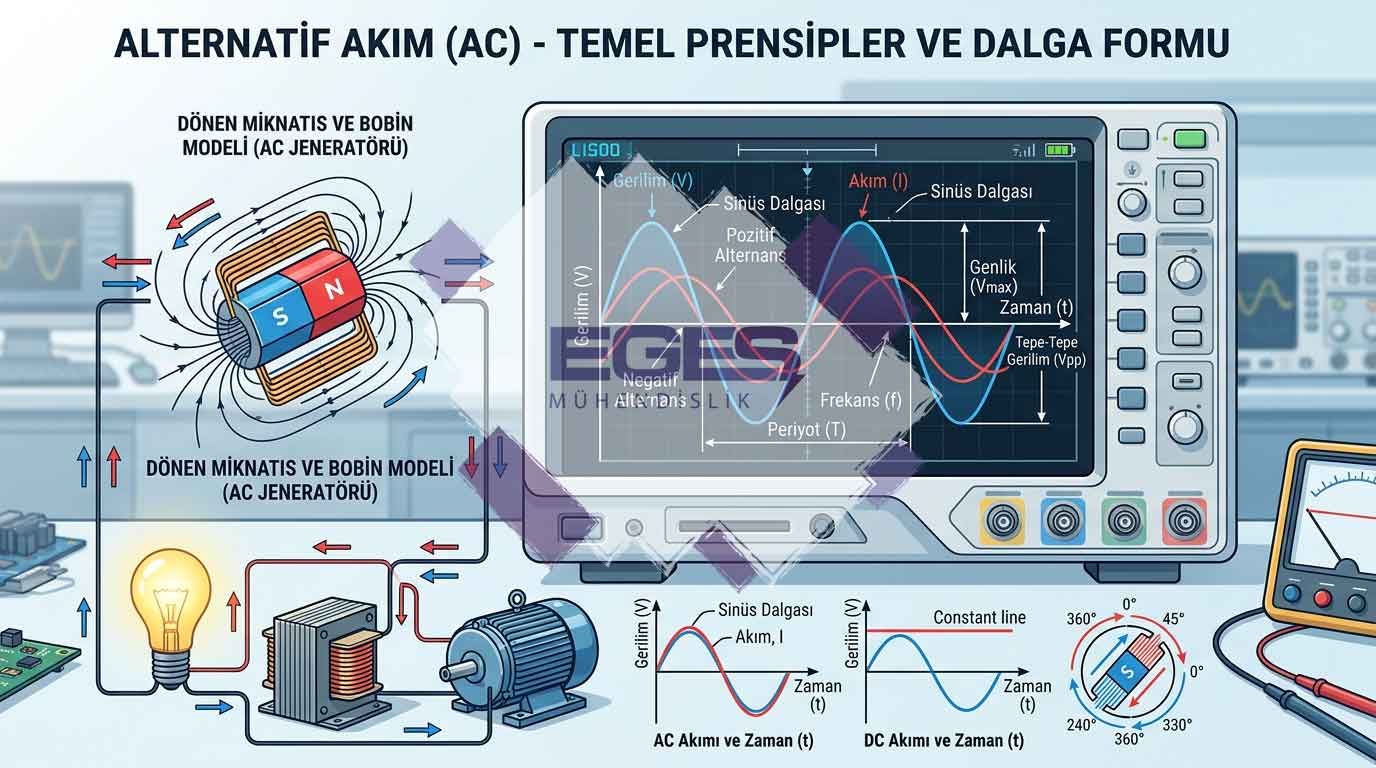
A large portion of the energy that lights up the modern world, powers factories, and reaches all the way to the outlets in our homes is alternating current. So, this energy that we use every day What is electric current? And why do we prefer alternating current (AC) over direct current (DC)?
What Is Current? What Does "Current" Mean?
Before getting into a technical definition, let’s focus on the most fundamental question: What does "Akim" mean?? In electricity, current is the flow of electric charges (electrons) through a conductive material (usually a wire). What is current? The physical quantity corresponding to this question is the amount of charge that passes through per unit time. This flow is caused by electrons being pushed in one direction.
What Is Alternating Current? (What Is AC Current?)
Well, What is alternating current?? Alternating Current (abbreviated as What is AC current? (as the answer to the question), it is a type of current whose direction and magnitude change periodically over time. Unlike direct current (DC), in alternating current, electrons oscillate by continuously moving back and forth.
Used in the industry What is an alternative? This expression represents the direction of the current changing a certain number of times per second (50 Hz in Turkey, meaning 50 times per second).
Who Invented Alternating Current?
Alternating current emerged victorious in the “War of the Currents,” one of the greatest controversies in the history of electricity. So, Who invented alternating current??
The genius who made the practical use of alternating current and its application to the modern electrical grid possible Nikola Tesla... In contrast to Thomas Edison’s insistence on direct current (DC), Tesla proved that alternating current could be transmitted over much greater distances with minimal loss.
Why Do We Use Alternating Current?
Alternating current The main reason these systems are preferred is that their voltage can be easily increased or decreased using transformers.
- As the electricity generated at power plants is transmitted thousands of kilometers away, its voltage is increased (to reduce heat loss).
- When it reaches the city, however, it is stepped down to safe levels for use in our homes thanks to transformers.
In Summary: The Difference Between AC and DC
- Alternating Current (AC): Electricity from outlets. Its direction can be changed, and it’s easy to transmit over long distances.
- Direct Current (DC): Electricity in batteries, rechargeable batteries, and electronic devices (phones, laptops). Its direction is fixed.
 Turkish
  English
  German
  French
  Arabic
  Azerbaijani