
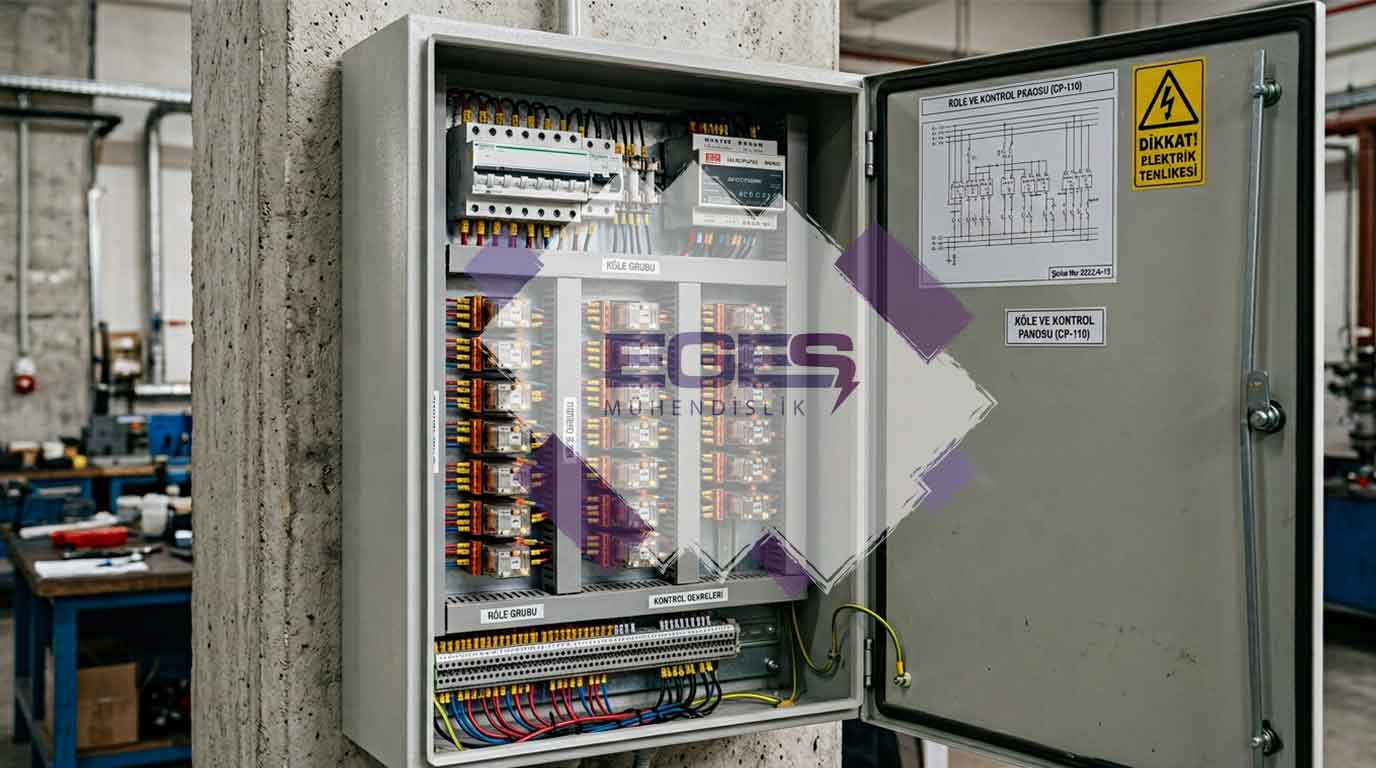
One of the most fundamental yet critical components of electrical systems is relay, is an electromagnetic switch that allows us to control high-current circuits using low currents. In the industry, it is sometimes role These devices, also known as [...], are an indispensable part of modern automation and security.
What Is a Relay and What Does "Relay" Mean?
According to the dictionary definition What does "relay" mean? The simplest answer to this question is that it is a “remote-controlled switch” that turns a circuit on and off. It typically operates using a small electromagnet (coil). Electric relay, triggered by a small current passing through it, safely turns on or off a higher-power system (such as a motor, a heater, or a lighting fixture).
How a Relay Works: How Does a Relay Work?
How a Relay Works, is based on the fundamental laws of electromagnetism. So, technically How does a relay work??
- Coil Triggering: When current flows through the coil inside the relay, a magnetic field is generated.
- Contact Movement: This magnetic field attracts a moving metal part (armature) toward itself.
- Circuit Completion: When the fixture moves, the contacts touch each other and an electric current is transmitted to the main circuit.
During this process, the low-voltage control circuit and the high-voltage power circuit are electrically isolated from one another.
What Are the Different Types of Relays?
Depending on their intended use and how they work, there are many different Types of Relays is located:
- Time Relay: It turns the circuit on or off after a specified period of time.
- Thermal Relay: In the event of an overcurrent, it heats up and breaks the circuit, thereby protecting the motors.
- Phase Protection Relay: It monitors phase imbalances in the grid.
- SSR (Solid-State Relay): These are electronic relays that contain no mechanical parts.
Relay Symbols and Circuit Diagrams
While reading the project relay symbol Knowing this is essential for understanding the logic of the circuit. In technical drawings, a relay is typically represented by a rectangle (the coil) and the switch lines (contacts) next to it. These symbols indicate whether the relay is in the “Normally Open” (NO) or “Normally Closed” (NC) state.
What Are Relay Panels Used For?
What is a relay used for? The answer to this question is clearer when looking at the panels. Relay panels enable complex control logic to be managed from a single central location.
- Provides Protection: In the event of a malfunction, it puts the rest of the system into protective mode.
- Logical Check: It manages the operation of multiple interconnected devices in a specific sequence.
- Security Isolation: It prevents people from coming into direct contact with high-voltage switches, allowing the system to be controlled using low-voltage buttons.
 Turkish
  English
  German
  French
  Arabic
  Azerbaijani